

Burden: The Work That Lives Between the Steps
Most annual reports have a page about people. It gives a headcount, a figure for staff costs and, often enough, some version of the sentence that people are the company's greatest asset.
The same report will value the buildings and the machinery in thousands of pounds. It will say how quickly they are wearing out, and set money aside to replace them.
The sentence is true
People being the greatest asset is usually read as a courtesy. It is closer to a literal description.
Take the people away and what is left is a set of contracts, a brand and some property. None of it can notice a problem, weigh a decision or work out what to do when the plan stops fitting the facts.
Every capacity an organisation claims, to plan, to judge, to adapt, is the capacity of the people in it to think, used inside the conditions the organisation has set for them. There is nowhere else for it to be. So why does the annual report know so much more about the machinery than about the conditions its people think in?
The obvious next step
If an organisation is its people, the natural move is to look at the people. A great deal of what organisations have built to understand their workforce does exactly that, asking how people feel or inferring it from how they work.
People are the most complex thing an organisation contains. An AI system is now tested against long batteries of evaluations before it is trusted with real work, while the people who use it are read through a few dozen survey questions, often once a year, which an earlier essay in this series showed stop short of whatever produced the answers.
A sharper instrument pointed at people is not the answer. The more complex the person, the less sense it makes to model them from outside, and the more sense it makes to read the one thing the organisation actually controls, which is the conditions around them.
The six pillars of working life
Across a great many accounts of working life, those conditions gather into six areas. This publication calls them the six pillars of working life, and each one decides something about how much thinking people are able to do.
Workload is how much work arrives, from how many directions, and whether it fits the time and skills available. It settles how much capacity is already spoken for before any thinking starts, and too little work, or the wrong kind, wastes capacity as surely as too much.
Tools and process are what the work is done with and the steps it has to pass through. A system that cannot hold the field the team actually needs, or an approval that adds a day and no judgement, takes capacity that should have gone into the work and spends it on working around it.
Clarity is whether people know what is expected of them, where their role ends and who decides. Where it is missing, people spend their thinking on guessing. It is lost less often through one bad announcement than through two reasonable ones that contradict each other.
Purpose is whether the work connects to something the organisation has said matters, and whether anyone can see what it produced. It points capacity somewhere. It tends to survive the first change of plan better than the third.
Flow is whether work can be carried from start to finish without being broken up. Hard problems need thinking that builds over an hour or a morning, and interruptions, waiting on other people and a pace that never settles all cut it off before it gets anywhere.
Collaboration decides whether people's thinking adds up or cancels out: whether information passes, whether help is there and whether a concern can be raised at all. Psychological safety lives here, and it gets a good deal of attention, rightly. It is one condition, in one pillar of six.
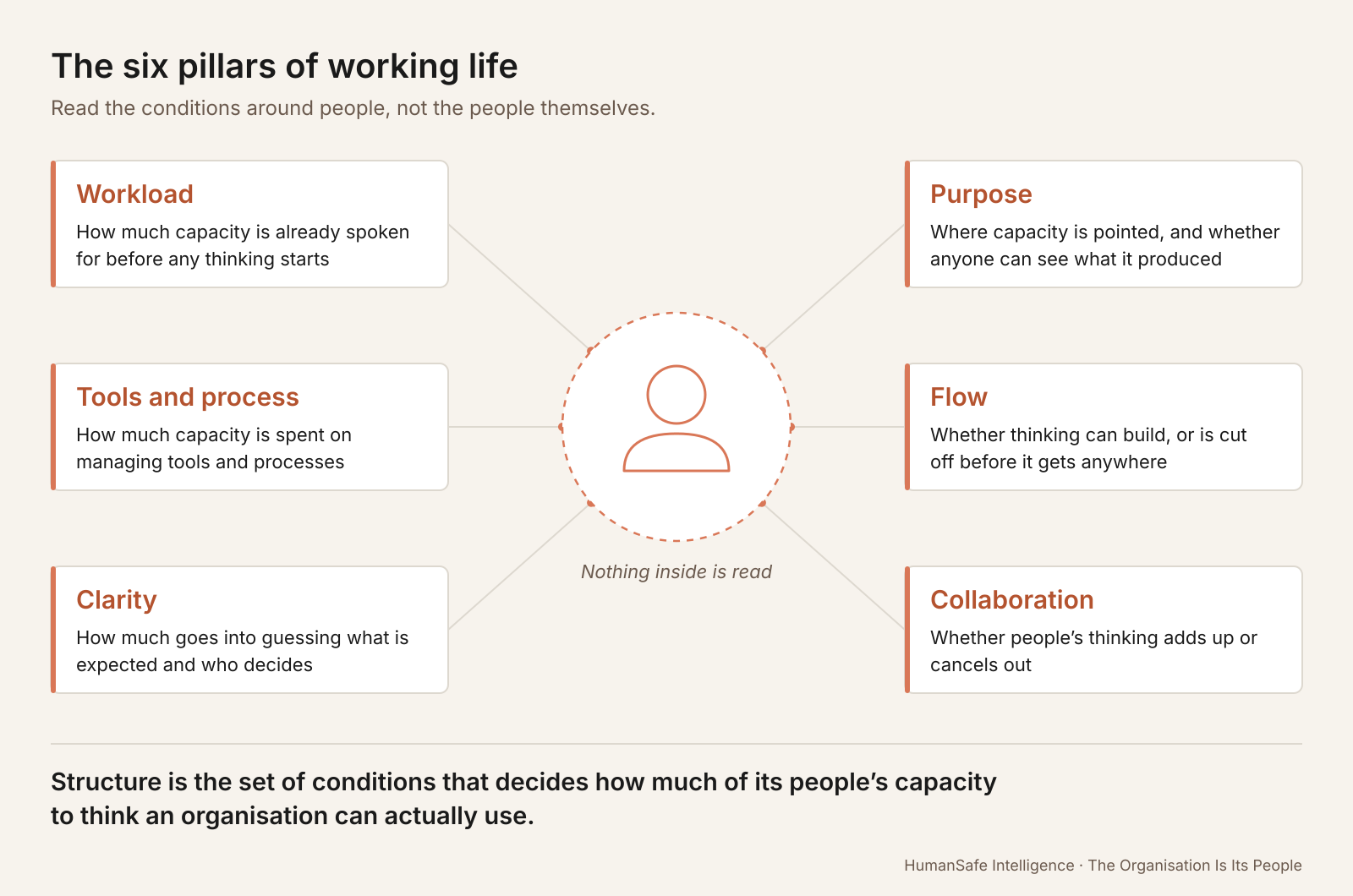
None of the six describes a person. Each describes something the organisation arranged, usually without meaning to, and each can be changed by whoever holds the authority to change it.
What structure is
When this series has talked about structure, it has never meant the organisation chart. A chart shows who reports to whom and says almost nothing about whether any of them has room to think.
Structure is the set of conditions that decides how much of its people's capacity to think an organisation can actually use.
An organisation's capacity to think is its people's capacity, less whatever the conditions take away. That puts structure around the people, in the week they actually have, rather than above them in a diagram, and it explains why structure has been so hard to see: the conditions exist only inside people's working weeks, where the person doing the work, as the last essay argued, is the only witness.
Where behaviour ends
The definition draws a line that most organisations blur. Behaviour belongs to a person and leaves with them. A condition belongs to the arrangement and is waiting for whoever sits in the chair next.
A good deal of what gets treated as behaviour sits on the wrong side of that line. The manager who seems disorganised may be taking requests from four directions with no shared view of what is already promised. The team that seems to resist change may be on its third system in a year, each one introduced with a launch and none of them retired.
Read through the pillars, the same facts stop being a verdict on people. They become a description of an arrangement, and an arrangement can be changed.
How often, as well as where
Conditions also move, and they rarely announce it. A pillar can weaken over a few weeks without a single decision anyone would recognise: a second system arrives before the first is retired, a priority changes and nobody restates it.
So understanding structure is a question of how often as well as where. A reading taken once a year describes an arrangement that has already changed. The tempting answer is to watch more closely and more often, and that is the trap this series described at the start: an organisation that reads its people continuously and still cannot see the conditions they work in.
Keeping pace with conditions without watching anyone is possible, and the closing essay in this series is about how. The next one is about what happens to people when nobody keeps pace at all.
Opinion: Taking the Sentence Seriously
We hold that an organisation is its people, without qualification. Its capacity to think, decide and adapt is theirs, and it rises and falls with the conditions they work in.
It follows that the way to understand how well an organisation can think is not to look inside its people. It is to read the conditions around them, as often as those conditions change, and the six pillars of working life are where to read them.
That leaves the annual report with a gap a board might want to sit with. It can say what a machine is worth and how fast it is wearing out. A board that believes its own sentence about people has nothing in front of it that says how much of those people's thinking the organisation is actually able to use.
Your response
The gap the essay ends on sits in every organisation, and some of its conditions are visible from wherever you are. Describe one of them, and the pillar it belongs to.
Describe the arrangement rather than how it feels, and leave the organisation unnamed. Responses are welcome in the comments where this essay is shared on the HumanSafe Intelligence Company Page.
Earlier in this series
Essay one, The End of Structured Thinking.
Essay two, The Most Measured, Least Informed Person in the Room.
Essay three, The Organisation Nobody Chose.
Essay four, What the Survey Cannot Ask.
Essay five, The Last Room Left.
Essay six, What the Tasks Were Hiding.
Essay seven, From Feeling to Structure.
Declaration of Generative AI and AI-assisted technologies in the writing process:
The author made use of Generative AI or AI-assisted technologies in the preparation of this post.
The contents of this article are for informational purposes only and do not constitute professional, legal, or financial advice.